Alpharetta is the anchor market for North Fulton capital deployment — the submarket where institutional-grade commercial demand, the highest concentration of Fortune 500 technology tenants in Georgia, and a $147,000 median household income converge to create the most defensible JV equity and mezzanine financing environment in the Atlanta MSA. Operators working with Pillar Partners treat Alpharetta as the benchmark against which all other North Fulton submarkets are measured.
The Avalon mixed-use district, the GA-400 technology corridor from Mansell Road to Old Milton Parkway, and the emerging City Center Phase 2 development zone collectively represent the most active commercial capital absorption market in Georgia outside the Atlanta urban core. This guide provides the capital structure mechanics, property tax environment, and deal structure intelligence that qualified operators need to compete in Alpharetta's 2026 market.
"Alpharetta's 71% college-educated workforce and $147,000 median household income make it the most defensible institutional-grade real estate market in the Atlanta MSA."
Alpharetta's Commercial Real Estate Landscape in 2026
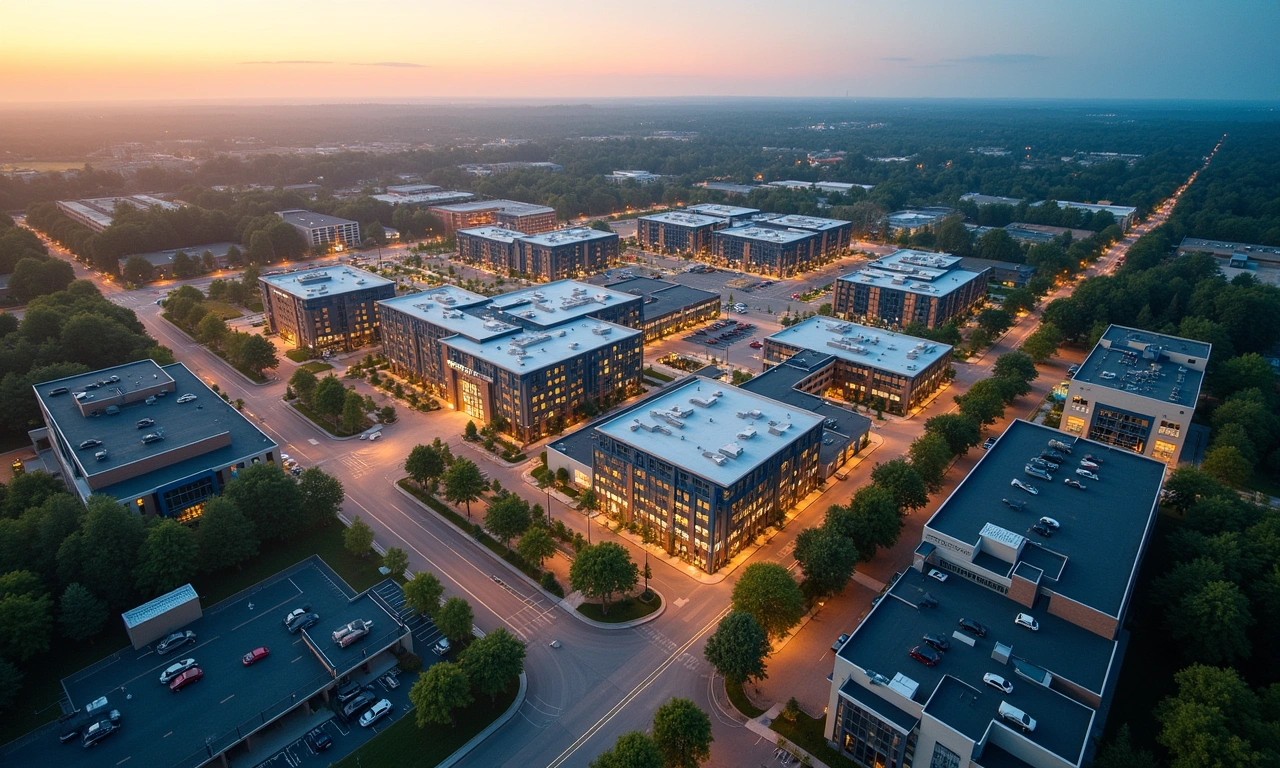
Alpharetta's commercial real estate market in 2026 is defined by three demand drivers that are unlikely to reverse on any 3-to-5-year investment horizon: the continued expansion of Technology Park East along the GA-400 corridor, the Avalon Phase 2 mixed-use development bringing additional Class-A retail and residential to the district's commercial core, and the City Center master plan that is converting the historic downtown grid into a walkable mixed-use environment. Each of these drivers creates a distinct capital deployment opportunity with different structure requirements.
The demographic foundation undergirding all three is exceptional. Alpharetta's 71% college-educated population base and $147,000 median household income rank it among the top five suburban markets in the entire southeastern United States by income and education concentration. This workforce profile is not merely an indicator of residential quality — it is the direct demand driver for the technology office, upscale retail, and premium multifamily product that all three development corridors are delivering. Operators who underwrite to this demographic base, rather than to backward-looking comparable rents, consistently outperform the submarket on a risk-adjusted basis.

JV Equity Structures for Avalon-District Mixed-Use
Avalon-district mixed-use development operates on a capital stack structure that differs from standard commercial because the mixed income streams — retail at grade, office above, and residential in the upper floors — require a senior lender, mezzanine layer, and equity tranche that each underwrite to a different income component. The typical structure for an Avalon-adjacent mixed-use project runs a 65% LTV senior debt layer plus a 20% mezzanine preferred equity layer plus a 15% GP equity contribution, producing a fully leveraged capital structure that can support the development cost basis for Class-A Avalon-adjacent product.
The preferred return on the mezzanine layer in Alpharetta mixed-use structures typically ranges from 9% to 11%, reflecting the premium the market commands relative to suburban markets with less robust income demographics. The GP equity contribution at 15% is consistent with what institutional LP capital sources require as an alignment mechanism in a market where development costs are this high. Our bespoke equity matching process connects Alpharetta operators with LP capital sources whose return parameters and hold period expectations are calibrated to the Avalon-district development cycle. All capital structure figures are illustrative only and do not constitute investment advice.
GA-400 Corridor: Bridge Financing Opportunities
The GA-400 corridor from Haynes Bridge Road to Old Milton Parkway constitutes Alpharetta's primary acquisition-to-development bridge financing market — a stretch of aging Class-B office and flex-industrial product that, given the corridor's technology tenant demand, is systematically undervalued on its current rent roll relative to post-renovation income potential. Bridge capital structures designed for GA-400 corridor acquisitions typically run 18 to 24 months, reflecting the longer entitlement and construction timeline for projects that require full repositioning rather than simple cosmetic renovation.
The acquisition-to-development bridge structure for a GA-400 corridor property involves an initial acquisition bridge at 60% to 65% LTV, funded at closing, followed by a construction draw facility that advances against confirmed construction progress. Our institutional bridge loan program structures these facilities with the draw mechanics and covenant packages that technology-corridor repositioning projects require. The bridge term must account for the time required to achieve stabilized occupancy in a technology office market where tenants often sign 36-month leases rather than the shorter terms typical in retail.
Alpharetta Property Tax Environment
Alpharetta's effective property tax rate of 11.74 mills — the combined Fulton County and City of Alpharetta millage rate as reported by the Fulton County Assessor's Office — sits at the middle of the regional comparison set. This 11.74-mill burden is lower than Gwinnett's 14.71 mills and DeKalb's 13.35 mills, positioning Alpharetta as a tax-efficient institutional market relative to the inner-ring Atlanta suburbs. On a $2 million assessed commercial asset, this translates to approximately $23,480 per year in property tax, which at typical Alpharetta commercial NOI ratios represents a manageable 3% to 4% of gross revenue drag on the income statement.
The Georgia Tech Research Corporation consistently benchmarks Alpharetta as a premium technology market within the Atlanta region — a designation that both reflects and reinforces the submarket's ability to command the rent levels necessary to absorb the 11.74-mill tax environment without NOI compression. NIST Building Standards provide the construction quality framework that institutional lenders require for Alpharetta Class-A deals, ensuring that the building quality delivered matches the rent premium the market supports.
Mezzanine Capital for Alpharetta's Highest-Value Deals
Alpharetta's highest-value commercial deals — Class-A technology office above $10 million, Avalon-adjacent mixed-use above $15 million — require mezzanine financing as a structural component, not an optional enhancement. At these deal sizes, the gap between 65% LTV senior debt and the total capital requirement is too large for GP equity alone to fill, making mezzanine preferred equity the essential bridge between senior debt and the equity stack. Our complete mezzanine financing guide covers Alpharetta-applicable structures in detail.
The mezzanine market for Alpharetta commercial deals in 2026 is active, with LP capital sources competing for exposure to the submarket's rental growth trajectory and exit cap rate compression. Operators who can demonstrate a credible lease-up timeline, a strong operator track record, and a GP equity contribution at or above 15% can access mezzanine capital at preferred return rates in the 10% to 12% range — a cost of capital that is fully supportable by the NOI that Alpharetta's technology and mixed-use tenants generate. Access the capital network directly through our capital access portal for a 48-hour review of your Alpharetta deal.
Infographic
Alpharetta Capital Stack Quick Reference
Data Visualization
Alpharetta Capital Structure Deal Volume — Deals Indexed 2022=100
* Illustrative market estimate. Not investment advice. Past performance does not guarantee future results.